Buying Property in Costa Blanca (2026): Best Areas, New Builds, Costs & Steps

Buying property on the Costa Blanca comes with a lot of practical decisions — where to buy, what it really costs, and how the process works in Spain. This page brings the essentials together in one place, so you can compare areas and property types, understand the key steps, and avoid common mistakes before committing.
In this guide:
What Is the Costa Blanca — and Who It Suits
The Costa Blanca is one of Spain’s best-known Mediterranean coastlines, located in Alicante province (Valencian Community) in south-eastern Spain. It stretches roughly from Dénia in the north to Pilar de la Horadada in the south — more than 200 km of beaches, marinas, cliffs, promenades and coastal towns, with inland villages just a short drive from the sea.
Costa Blanca North vs Costa Blanca South (in simple terms):
Costa Blanca North is generally hillier and known for coves, sea views and villa areas. Costa Blanca South is flatter, with long sandy beaches and many established residential communities.
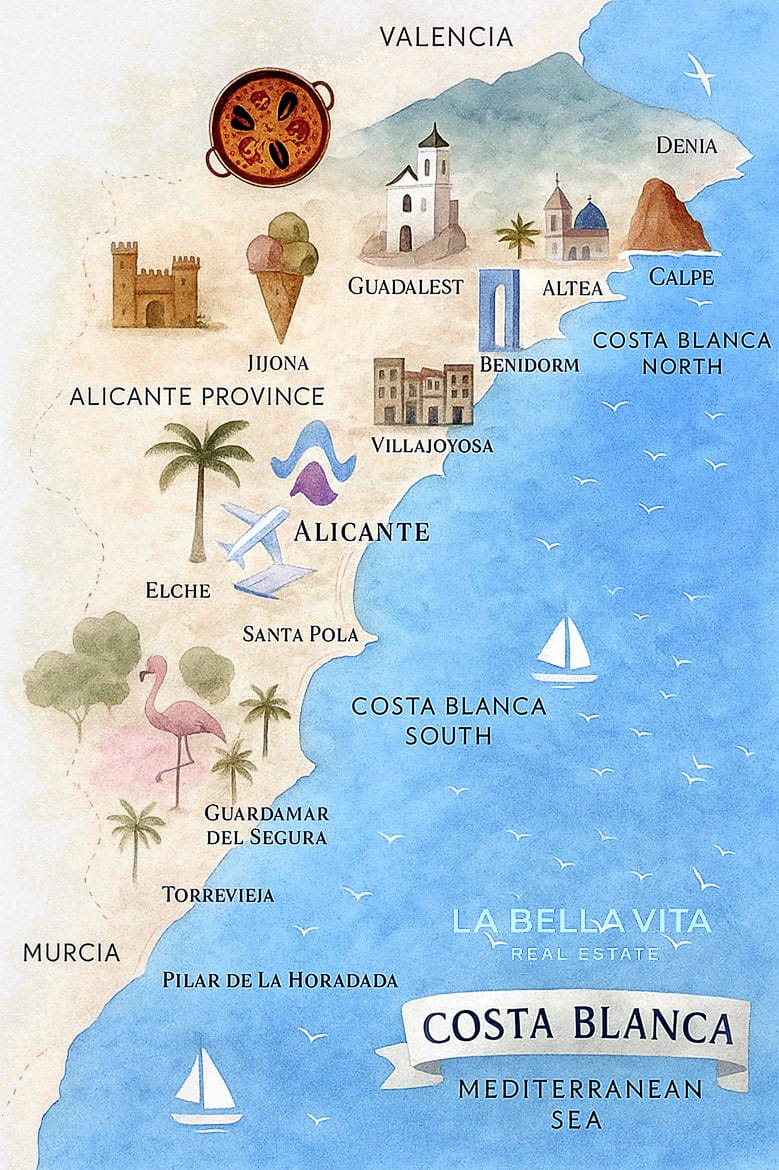
The region includes well-known locations such as Alicante city, Benidorm, Altea, Jávea, Torrevieja, Guardamar del Segura and Orihuela Costa, alongside smaller coastal towns and quieter inland areas.
Who is it for?
This region suits a wide range of buyers:
- Holiday-home buyers
A lock-and-leave apartment or townhouse close to the beach, restaurants and transport. - Families & remote workers (all-year living)
Buyers who prioritise daily convenience: schools, healthcare, supermarkets, good internet, parking and a normal routine beyond holiday season. - Retirees
A comfortable, easy lifestyle with mild winters, good services and communities where settling in is straightforward. - Investors & long-term potential
Options for holiday or long-term rentals, plus areas where new development and improving infrastructure can support future value growth.
Many buyers fit more than one category — the key is choosing an area that matches your main priority first.
Alicante leads Spain for foreign buyers
In 2025, Alicante (Costa Blanca) stood out as Spain’s top province for international demand. In one quarter (Q2 2025), around 4 in 10 home purchases in Alicante were made by foreigners — the highest share in the country.
Why Buy Property in Costa Blanca in 2026?
For many international buyers, the Costa Blanca offers a rare mix: Mediterranean lifestyle, strong infrastructure, and a wide range of property options — from coastal apartments to golf communities and inland homes. Below are the main reasons people choose to buy here.
Climate and Lifestyle
The Costa Blanca is known for one of Spain’s most comfortable Mediterranean climates — with mild winters, warm summers, and enough sunshine to make outdoor life feel easy for much of the year.
Costa Blanca Climate at a Glance:
- Winter (Dec–Feb): daytime ~16–18°C, nights ~6–8°C (AEMET)
- Summer (Jun–Aug): daytime ~29–31°C, nights ~20–23°C (AEMET)
- Sea temperature: ~15°C in winter, ~25–26°C in summer (SeaTemperature.info)
International Community
The region has a strong international population alongside Spanish residents, which often means:
- Multilingual services
- International schools
- Diverse restaurants and shops
- Established communities where newcomers often settle in quickly
Infrastructure and Connectivity
The Costa Blanca is well connected, with:
- Alicante–Elche Airport and frequent international flights
- Motorways and national roads along the coast
- Train and tram links between key cities
- Ferries from Dénia to the Balearic Islands
- Modern shopping centres, marinas and sports facilities
This makes travel easy — whether you’re visiting regularly, staying longer periods, or planning to rent out the property.
Practical Services and Everyday Convenience
Because more people now live here permanently, there are:
- Schools and international schools
- Public and private healthcare
- Supermarkets and shopping centres open all year
- Sports clubs, gyms and wellness centres
- Coworking spaces, language schools and social clubs
You are not limited to a “summer only” lifestyle. You can live a comfortable, normal life twelve months a year.
A Market That Works for Different Buyer Goals
The Costa Blanca attracts different types of buyers:
- Holiday homes close to the sea
- Homes with more space and storage for longer stays
- New builds with modern design and energy efficiency
Many buyers want a combination — a home they can enjoy personally, with the option to rent when they’re not using it.
A Buyer-Friendly Legal Framework (With the Right Checks)
Spain has a well-established legal and banking system for property purchases. When the process is handled properly, buyers benefit from several layers of protection that are designed to create clarity and peace of mind:
Clear ownership records: properties are recorded in the Land Registry, which helps confirm who owns what and whether there are registered charges.
Structured contracts and notary completion: the final purchase is signed before a notary, with formal documentation and registration procedures.
Protection of payments (especially for new builds): in many cases, stage payments must be handled with formal guarantees or protected mechanisms, which your lawyer verifies.
Professional standards in the sector: agents and agencies need to meet registration requirements and carry professional insurance, which adds another layer of accountability.
 The system is designed to protect buyers — your goal is simply to make sure the correct checks are done and the paperwork matches the reality. An independent lawyer helps confirm this before you commit significant funds.
Taken together — lifestyle, connectivity, practical services and a buyer-friendly process — the Costa Blanca remains one of Spain’s most attractive regions for international buyers in 2026. And as the market has matured, you can also see a clear shift in what people look for: not just a small summer base, but a more complete home with space, storage, parking, and layouts that work beyond occasional visits.
👉 Read more: Costa Blanca Property Market Trends (2026)
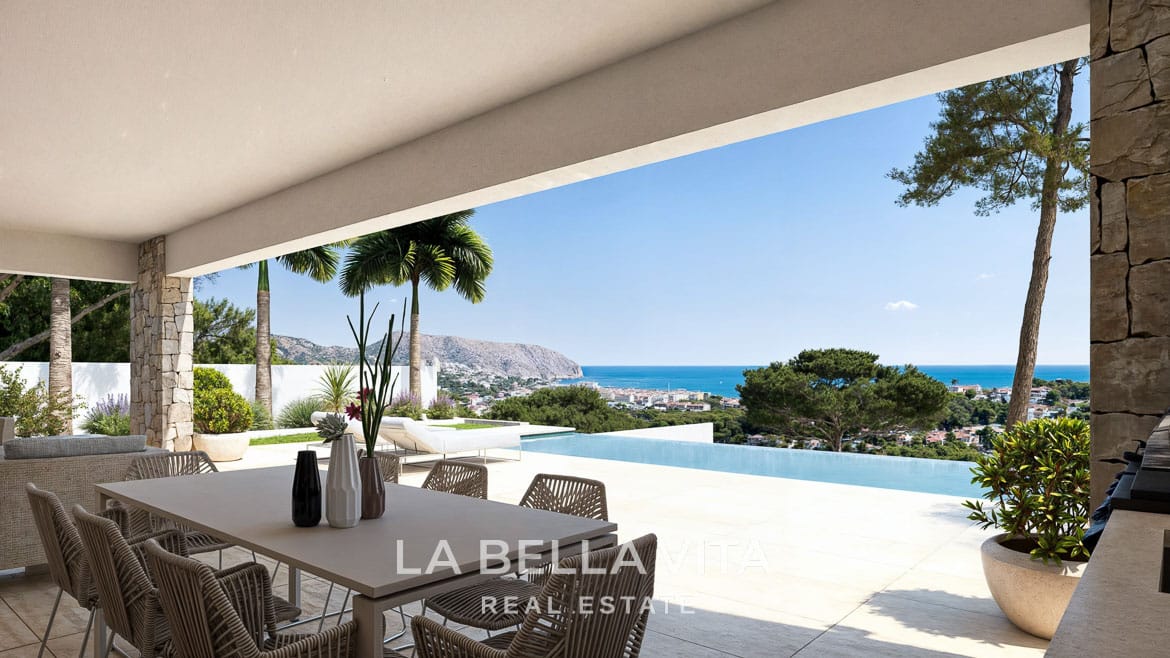
Now that you understand why buyers choose the Costa Blanca, the next step is deciding where to focus your search. Different areas suit different priorities — beach access, golf, schools, walkability, views, or budget — and this decision usually matters more than the property itself. Below is a practical overview of the best areas to consider, from south to north.
Best Areas to Buy Property in Costa Blanca (From South to North)
Below is a practical tour of the key areas buyers focus on when looking for property on the Costa Blanca — starting at the southern end and moving north toward Dénia. Each area has a different “feel”, different property types, and a different price logic, so it’s worth narrowing your shortlist by lifestyle first.
In broad terms, Costa Blanca South tends to offer:
- Slightly milder winters and a drier feel
- Flatter landscapes with long sandy beaches and promenades
- Many golf resorts and planned residential communities
While Costa Blanca North is often known for:
- More dramatic coastline with coves and cliff views
- Hillier terrain and more “scenic” residential zones
- Some of the coast’s most exclusive villa areas
Tip: there are excellent choices in both — the best area is the one that matches your priorities: beach walkability, views, golf, schools, or budget.
Northern Costa Blanca: Calpe, Benissa, Moraira & Jávea
Further north, the coastline becomes more dramatic and scenic. Areas such as Calpe, Benissa, Moraira and Jávea (Xàbia) are known for coves, cliffs and sea-view residential zones, and they sit among the most sought-after premium addresses on the Costa Blanca.
What makes this stretch special:
Cliffside landscapes, hidden coves and clear-water beaches
A strong focus on villas and upscale homes, many with panoramic sea views
A lifestyle that leans toward privacy, views and character rather than large resort-style developments
High-quality amenities, including beach clubs and destination restaurants, plus a more boutique / bohemian feel in certain towns
A well-established international market, with consistent interest from buyers looking for a premium coastal setting
These locations are a great fit if you’re looking for a scenic, prestige-oriented part of the Costa Blanca where the landscape is a major part of the appeal.
Types of Properties Available on the Costa Blanca
If you’re new to the Costa Blanca market, property terminology can be confusing — especially because some words mean something different here than in other countries. Below are the main property types you’ll see, with quick explanations to help you choose the right fit.
Quick guide: what fits you best?
- Apartment → low maintenance, shared amenities, lock-and-leave
- Bungalow → an apartment with extra private outdoor space (garden/terrace or solarium)
- Townhouse → multi-level home, attached on one or both sides, often within a community
- Linked villa / semi-detached / quad → villa-style living with a shared wall; usually private outdoor space + parking, private pool
- Detached villa → maximum independence; a private, more spacious plot, often private pool + garage/parking
- Country house / rustic → independent home with a large plot/land, more privacy and space for outdoor living or personal projects

Apartments
Apartments are one of the most common property types on the Costa Blanca, especially in new-build communities. You’ll typically find them in:
-
Low- to mid-rise residential blocks in suburban or coastal neighbourhoods
-
High-rise buildings in more urban or seafront zones (for example, parts of Benidorm)
Typical features include:
-
Communal swimming pool and shared gardens
-
Children’s play areas and landscaped community spaces
-
In some developments: gym, spa, coworking room or social lounge
Best for:
-
Lock-and-leave use (holiday or part-time stays)
-
Seasonal or long-term rentals
-
Buyers who want low maintenance and shared facilities
Good to know: Apartments usually come with community rules and monthly fees, so it’s worth checking what’s included (maintenance, pool, security, lifts, etc.) before you decide.
Bungalows (Ground Floor & Top Floor)
The word “bungalow” on the Costa Blanca can be confusing — it doesn’t mean a single-storey house like in many other countries.
Here, a bungalow usually means a two-level building split into two independent homes:
Ground floor bungalow — private garden or terrace
Top floor bungalow — private solarium (roof terrace)
Legally, they’re typically classed as apartments, but they feel more like a small home because you get your own outdoor space and a more “house-like” layout.
Why buyers love them:
Ground floor bungalows are great for families, pet owners, and anyone who wants step-free outdoor access
Top floor bungalows suit sun lovers who want a large terrace for dining, sunbathing, and entertaining
Townhouses & Linked Homes
Townhouses and linked homes are a popular middle ground between an apartment and a detached villa — often more affordable, but with some of the key advantages of a house: private outdoor space, terraces, and usually parking on the plot (depending on the community). In many developments you’ll find either a communal pool or, in some formats, a private pool.
Typically, they offer:
-
1-3 floors, often with internal stairs
-
A private patio/terrace, sometimes a small garden
-
In many new builds: a roof solarium, basement/underbuild, and private parking
Quick difference:
-
Townhouse = usually attached on both sides (in a row)
-
Quad = typically a corner-style home in a block of four (often attached on one side, sometimes two depending on the layout)
-
Semi-detached = attached on one side only, usually the most “villa-like” feel
Detached Villas
Detached villas are ideal for buyers who want maximum independence and privacy — no shared walls and typically more outdoor space.
Typical features:
A private garden/terrace and outdoor living areas
Private pool in many homes (or the option to add one, depending on the project)
Parking on the plot or a garage
Sometimes a basement/underbuild, useful for storage, extra bedrooms, a home office, gym, cinema room, etc.
New-build villas are especially attractive for buyers who want more comfort and space — whether for family use, longer stays, or working remotely — and who prefer a modern layout with efficient energy standards.
Good to know: Villas come with more independence, but also more responsibility (garden/pool upkeep), so it’s worth planning for running and maintenance costs.
Country Houses / Rustic Properties (Fincas)
Country and rustic properties (often called fincas) offer a very different lifestyle from coastal apartments and villas — more land, privacy and nature, usually in inland areas rather than directly on the coast.
Typical features:
Homes on larger plots (rustic or semi-rural land)
Views of vineyards, almond and olive groves, and open countryside
A quieter setting and more space for outdoor living (gardens, trees, hobby projects)
These properties suit buyers who want authentic Spanish countryside charm and don’t mind being a drive away from beaches and major coastal towns. They’re most common in inland Alicante province, where you can still reach the coast when you want it, but enjoy a more private environment day to day.
Good to know: Rustic homes can have different legal/land classifications and utility setups, so your lawyer should confirm documentation, boundaries and registrations carefully.
Your Budget on the Costa Blanca: Typical Price Ranges by Area & Property Type
In 2026, Costa Blanca prices are easiest to understand through a South vs North lens — but the real driver is always the micro-location. Depending on the town, proximity to the sea, views and property type, price levels can range from around €1,800/m² to €5,000+/m² in the most premium locations.
What affects pricing most (ranked)
Micro-location: the specific neighbourhood, walkability, services, how built-up the area is, and overall “address quality”.
Sea proximity + views + orientation: walk-to-beach and open sea views can shift pricing dramatically.
Property type + size: apartments vs villas, built size, terrace size, and plot size.
New build vs second-hand: energy efficiency, layouts, insulation, lifts, parking/storage, and renovation needs.
Extras & community quality: pools, gyms, security, landscaping, parking solutions, and amenities.
Costa Blanca South (Torrevieja, Orihuela Costa, Guardamar…)
Apartments
Second-hand: ~€120,000–€350,000 (condition + sea distance are the biggest variables)
New build: ~€160,000–€460,000 (project level + proximity to the sea push the top end)
Villas
Second-hand: ~€250,000–€650,000+ (plot, renovation level, and address matter most)
New build: typically from €350,000+
Costa Blanca North (Altea, Dénia, Jávea, Moraira…)
Apartments
Second-hand: ~€180,000–€450,000+ (prime sea-view zones go higher)
New build: typically from €240,000+
Villas
Second-hand: ~€450,000–€1,200,000+
New build: typically from €450,000+
Luxury / exclusive: expect €1M+ for high-end sea-view villas in prestige micro-markets (especially North Coast).
Avoid the ‘perfect deal’ trap: ultra-cheap listings often come with trade-offs — location compromises, legal/urban planning issues, or major renovation needs. Compare homes by total cost to own, not just the headline price.
New Build vs Second-Hand Property on the Costa Blanca
Once you’ve chosen an area and set a budget range, the next big decision is whether you want a new build home (modern specs, staged payments, warranties) or a second-hand home (existing home you can assess immediately, sometimes more negotiable). Both can be a good choice — it depends on your timeline and priorities.
Why buyers choose new builds
Modern layouts + outdoor living: open-plan designs, larger terraces, brighter interiors, and practical use of space.
Lower maintenance: everything is new, and many projects include easy-care gardens and features like automatic irrigation.
Better energy performance: newer builds generally offer stronger insulation, modern windows, and more efficient heating/cooling than older stock.
Warranties & developer guarantees: new homes come with formal guarantees (structure and installations), adding peace of mind.
Customisation options: in many projects you can choose finishes (tiles, kitchens, colours) if you buy early enough.
Potential uplift during delivery: if you buy early in a project, values can increase as construction progresses and the community becomes established — so for some buyers, waiting can work in their favour (depending on the area and market conditions).
Staged payment structure: off-plan purchases often follow instalment payments during construction, which can make budgeting easier if you’re not in a rush to move immediately.
Why buyers choose second-hand homes
You get what you see: you can judge the real condition, light, noise, neighbours, and views right away, and in some cases move faster.
Established setting (often, but not always): many second-hand homes are in built-up neighbourhoods with mature streets and services already in place — although some new builds are also located in established areas, so this depends on the specific location.
Sometimes more land for the money: especially outside prime front-line coastal pockets, you may find larger plots or older villa formats that are hard to replicate in new developments.
Negotiation potential (sometimes): depending on the seller and condition, there can be more room to negotiate than with fixed-price new developments.
Lower entry price (in many cases): second-hand can look cheaper upfront — but renovations, upgrades and running costs can change the true “all-in” budget.
Important: New builds are usually unfurnished, and AC may be optional. Check the spec sheet for what’s included (appliances, lighting, shower screens, parking/storage, landscaping).
Step-by-Step Guide to Buying a New Build Property in Costa Blanca
1. Define your goal + must-haves
Before you search, clarify:
Are you buying for living, holidays, or investment/rental?
What’s your budget range (including extra costs)?
Preferred lifestyle: walk-to-beach, golf, town, or inland
Property type: apartment, bungalow, townhouse/linked home, villa
Non-negotiables: bedrooms, outdoor space, parking, lift, sea views, etc.
2. Property search and choosing the right agency
This is where good guidance saves the most time. A strong agency should:
- Guide you to the right locations based on your lifestyle, budget, and priorities
- Show and compare multiple developers/projects objectively
- Explain developer differences: specs, timelines, payment stages, and after-sales
- Clarify what’s included vs optional (parking/storage, appliances, A/C, lighting, etc.)
- Represent you end-to-end: shortlisting, viewings, developer communication, and the booking process
3. Reservation (hold the unit)
- When you choose the right property:
You sign a reservation document
Pay a reservation fee (often €3,000–€10,000, depending on the project)
The unit is taken off the market while legal checks begin
Good to know: Reservation deposits are often non-refundable, so before you pay, confirm the terms in writing — especially the reservation period and what happens if your lawyer finds a legal issue.
4. Legal checks (independent lawyer + documentation)
Your independent lawyer should:
Verify licences/permissions and developer documentation
Confirm Land Registry status (Registro de la Propiedad)
Check specs, deadlines, guarantees, and contract clauses
Explain everything clearly before you sign the main contract
5. Private Purchase Contract (PPC) + Payment Plan
After your lawyer finishes the checks, you sign the Private Purchase Contract (PPC) with the developer. This is the main contract that locks in the price, the unit, the timeline, and the legal protections.
The PPC should clearly confirm:
The full purchase price and what’s included (parking, storage, appliances/extras)
The exact property details (unit number, floor plan, surface areas, terrace/plot)
The building specification (memoria de calidades) and finishes
The estimated delivery date and what happens if it’s delayed
Guarantees and protections for your payments
Any penalties/conditions for breach by either side
Typical new-build payment structure (example):
Reservation deposit (to hold the unit)
10–20% upon signing the PPC
Stage payments during construction (often 10–30% total, split into milestones)
Final balance at completion, paid at the notary (when you get the keys)
6. NIE Number + Spanish Bank Account
To buy property in Spain, you’ll need an NIE (Número de Identificación de Extranjero) — a personal identification/tax number for foreigners. It’s required for key steps such as signing at the notary, paying taxes, and registering the property in your name.
A Spanish bank account is also strongly recommended (and often practically necessary) because it makes it much easier to:
Pay the purchase-related taxes and fees
Set up utilities (water, electricity, internet)
Pay community fees and ongoing bills
Manage mortgage payments (if applicable)
Good to know: If you work with an independent lawyer, they usually handle the NIE process and can assist with opening a bank account (or guide you through the easiest option), especially if you’re buying from abroad.
7. Completion at the notary (deed + keys)
The final step is signing the public deed of sale (escritura) in front of a notary. At this appointment:
The final payment is made
The escritura is signed (either in person or via Power of Attorney / POA)
Keys are handed over
The purchase is then registered in your name in the Land Registry
Before signing: we normally arrange a final property check (snagging / walkthrough) to confirm the home matches the specifications and everything is in order. Your agent can coordinate the appointment, assist with communication, and make sure the handover process goes smoothly.
Post-handover check: After you receive the keys, you may spot small finishing issues during the first weeks. We help you document them, report them to the developer, and follow up until they’re addressed.
Costs & Taxes When Buying Property on the Costa Blanca (2026)
When buying property on the Costa Blanca, plan an additional budget on top of the purchase price for taxes and purchase costs. The exact amount depends on whether the property is new build or second-hand, and whether you use a mortgage — but it’s normal to budget roughly 10–13% extra in many cases.
Taxes & purchase costs to consider
VAT (IVA) — new builds (first sale from the developer): usually 10% for residential property.
Transfer Tax (ITP) — second-hand homes: 10% in the Valencian Community until 31 May 2026, then 9% from 1 June 2026 (with higher rates applying in some high-value cases).
Stamp Duty (AJD) — mainly applies to new builds: 1.5% in the Valencian Community until 31 May 2026, then 1.4% from 1 June 2026.
Notary + Land Registry fees: often from a few hundred euros up to around €1,500+ combined, depending on the price and deed complexity.
Lawyer’s fees: commonly around ~1% of the purchase price (depends on scope of service).
Mortgage-related costs (if applicable): valuation, bank conditions/fees, and administrative costs (your bank will outline these before approval).
Good to know: In some cases (age, first home, family status, disability, etc.), reduced rates or deductions may apply — your lawyer can confirm what you qualify for based on your situation and the exact property.
Our service for buyers
We do not charge buyers a commission. Our fees are paid by developers and owners we collaborate with — so you benefit from local guidance, project comparison, and full support throughout the process at no extra cost to you.
Quick example (new build, €300,000)
If you buy a new build for €300,000 in Costa Blanca, a rough budget could look like:
IVA (10%): €30,000
AJD (1.5% until 31 May 2026 / 1.4% from 1 June 2026): €4,500 / €4,200
Notary + Land Registry (approx.): €800–€1,500
Lawyer: €2,000 – €3,000
Estimated total extra costs: roughly €38,300–€40,000 (plus mortgage-related costs if applicable).
This is an illustration only — final costs depend on the property, services used, and whether reduced tax rates apply.
In this guide:
FAQs About Buying Property in Costa Blanca
What are the most common mistakes buyers make?
Common ones include: choosing a home before setting an all-in budget, skipping legal checks, underestimating ongoing costs (community fees/utilities), and assuming every area feels the same year-round.
Can I get a mortgage in Spain as a non-resident?
Often yes, depending on your income, country, and the bank’s criteria. Mortgage approval can take time, so start early if financing matters.
What’s usually included in a new build price (and what often isn’t)?
It varies by developer. Many new builds are delivered unfurnished, and air conditioning may be optional or “pre-installation only.” Always confirm what’s included: appliances, A/C, lighting, shower screens, parking/storage, and landscaping.
How long does it take to buy a new build property?
If the property is already completed and you have financing ready, the process can be relatively quick (a few weeks or a couple of months). If you buy off-plan, the timescale follows the construction schedule – often between 6 and 18 months.
Can I rent out my new build property?
In many municipalities you can, but for short-term tourist rentals you may need a specific rental licence and must follow local regulations. Your lawyer and agency can explain the rules in the area where you are buying.
What ongoing costs should I expect after purchase?
Typical ongoing costs can include community fees, utilities, property tax (IBI), insurance, and maintenance (especially for villas with pools/gardens).
Not sure where to start?
Send us your budget + “must-haves” and we’ll match you with the best new-build options available right now.
Contact Us
LA BELLA VITA REAL ESTATE